
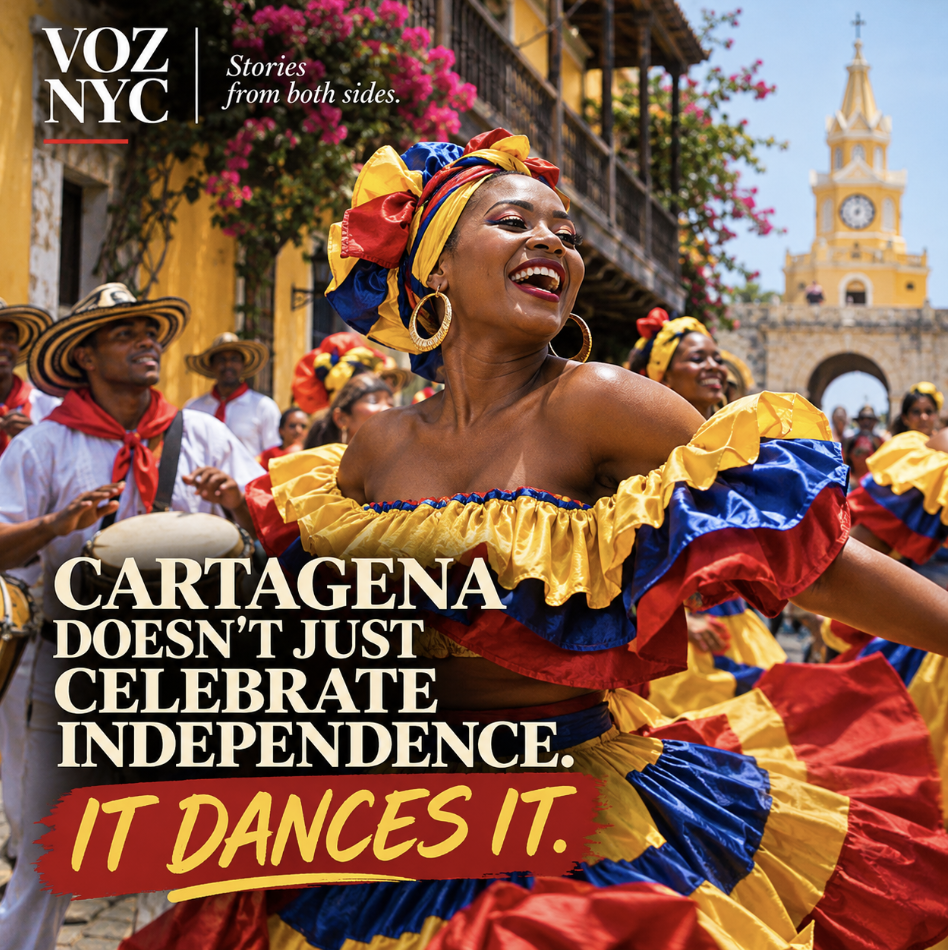
Every November, Colombia’s Caribbean jewel transforms into a celebration of freedom, music and cultural identity. But behind the colorful parades is a story of resistance that began 215 years ago.
Before the drums begin, before the dancers fill the streets and before the city disappears into a sea of costumes, music and celebration, there is a date that gives it all meaning.
November 11, 1811.
That was the day Cartagena declared its absolute independence from Spain, becoming one of the earliest cities in what is now Colombia to take that decisive step.
Two hundred and fifteen years later, the city still celebrates.
But Cartagena doesn’t commemorate its independence quietly.
It dances.
It sings.
It fills its streets with the unmistakable energy of the Colombian Caribbean.
And for the people who call Cartagena home, the Fiestas de Independencia are much more than a colorful spectacle.
They are a declaration of identity.
A revolution that came from the streets
Cartagena’s independence story cannot be told without Getsemaní.
Today, the neighborhood is internationally recognized for its colorful streets, murals, restaurants and lively plazas.
But in 1811, Getsemaní played a much more consequential role.
It was home to artisans, workers and people of African descent whose participation helped push the independence movement beyond political debate and toward decisive action.
Among its most important figures was Pedro Romero, a leader associated with the Lanceros de Getsemaní, a popular militia that demanded a definitive break with Spanish colonial rule.
Their involvement helped transform independence from a political aspiration into a movement with powerful popular participation.
That history remains central to the city’s celebrations.
Because Cartagena’s independence wasn’t simply a decision made behind closed doors.
Ordinary people helped make it happen.
The city becomes the celebration
Every November, Cartagena takes on a different rhythm.
Traditional drums mix with contemporary Caribbean sounds. Dancers rehearse elaborate choreographies. Neighborhood groups prepare costumes, floats and performances that celebrate the city’s cultural heritage.
The streets become stages.
The celebrations reflect Cartagena’s African, Indigenous and European influences, expressed through music, dance, clothing and traditions that have evolved over generations.
And while visitors may recognize the famous parades, the festivities extend well beyond the city’s historic center.
Community celebrations, known as cabildos, bring cultural performances and local traditions into neighborhoods throughout Cartagena.
These events are particularly important because they keep the celebrations connected to the people who sustain them.
The Fiestas de Independencia are not simply something residents attend.
They are something residents create.
More than queens and parades
For many people outside Colombia, Cartagena’s November festivities are associated with beauty pageants and large-scale celebrations.
But the popular festivities tell a deeper story.
The Reinado Popular de la Independencia, for example, brings together representatives of Cartagena’s neighborhoods and places community identity at the center of the celebration.
The city’s comparsas, dance groups and traditional performers also play a central role in preserving its cultural expressions.
And then there is Getsemaní.
The neighborhood’s traditional cabildo continues to connect contemporary celebration with the memory of the people who helped shape Cartagena’s independence.
These traditions are reminders that cultural heritage is not confined to museums or monuments.
Sometimes it survives through the people who gather in the streets to dance.
Cartagena celebrates 215 years of independence
This year’s festivities carry special significance as Cartagena commemorates the 215th anniversary of its 1811 declaration.
The official 2026 program includes historical tributes, neighborhood celebrations, traditional performances and major cultural events.
On November 11, the city will commemorate its independence with ceremonial activities, including the reading of the Act of Independence and floral tributes honoring its historical figures.
The following day, November 12, the Gran Desfile de Independencia is scheduled to bring thousands of performers to Avenida Santander.
The celebrations will continue with the Festival Náutico de la Independencia and Bololó del Arsenal on November 13 and 14, followed by the traditional Cabildo de Getsemaní and the Reinado Popular festivities on November 15.
The programming reflects an effort to celebrate both the city’s historical significance and the cultural traditions that continue to define it.
The Cartagena beyond the postcards
There is another reason the Fiestas de Independencia matter.
Cartagena is often presented to the world through its most recognizable images: colonial balconies, colorful streets, Caribbean sunsets and centuries-old fortifications.
Those images are beautiful.
But they tell only part of the story.
Beyond the postcards is a city shaped by working-class neighborhoods, Afro-Caribbean traditions, popular music, community organizing and generations of people who have contributed to its identity.
November offers a different way of seeing Cartagena.
Not simply as a destination, but as a living city whose history continues to shape its present.
The celebrations bring that identity into public view.
They remind visitors and residents alike that Cartagena’s greatest cultural inheritance isn’t found only in its architecture.
It’s found in its people.
Freedom has a rhythm
Two hundred and fifteen years after Cartagena declared independence, the meaning of freedom continues to evolve.
The city’s celebrations cannot erase the inequalities and challenges that remain part of contemporary life.
But they offer an opportunity to remember a history in which ordinary people played an extraordinary role.
A history shaped by resistance, collective action and the determination to define a different future.
And perhaps that’s what makes Cartagena’s November festivities so distinctive.
They don’t separate history from everyday life.
They bring it into the streets.
Into the music.
Into the movement of thousands of people celebrating a city that belongs to them.
Because in Cartagena, independence isn’t only something remembered.
It’s something you can hear, feel and dance to.

Leave a Reply