
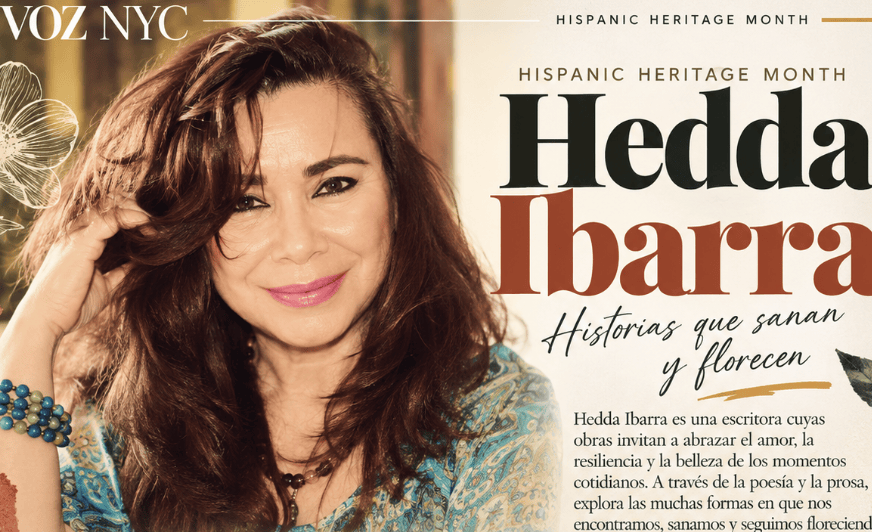
The Bogotá-born poet and journalist has spent years writing about migration, nostalgia, desire and the complicated experience of building a life away from home. For VOZ NYC, her story also feels unexpectedly familiar.
Some writers leave home and spend the rest of their lives trying to explain what leaving did to them.
For Colombian poet and journalist Hedda Ibarra, that explanation came in verse.
Born in Bogotá and now based in the United States, Ibarra has built a body of work around emotions that rarely fit neatly inside the word immigration: nostalgia, distance, memory, desire, family and the persistent pull toward the country left behind.
She once called some of those early works her “poemas migrantes.”
They weren’t originally meant for the world.
In a 2017 essay about her journey toward publication, Ibarra recalled keeping those poems to herself for years before finally deciding to let them go.
“Así fueron naciendo mis poemas migrantes como un acto de rebeldía,” she wrote, describing poetry as a way of releasing emotions that had remained inside her.
And that’s where her story becomes particularly personal for VOZ NYC.
Before the books, there was a connection
Years before VOZ NYC existed, Ibarra was looking for places willing to publish those poems.
One of the people she contacted was another Colombian journalist: José Martínez, today the founder and editor of VOZ NYC.
Ibarra later recalled that Martínez published some of her work through his former cultural project, YoSoyCultura. Her writing subsequently appeared in other literary spaces, including Argentina’s Conventillo Babel, Poesía a mano alzada and El Bodegón Literario, while her work also reached literary anthologies in Spain.
Nearly a decade later, their paths cross again.
This time, Ibarra isn’t simply a poet wondering whether anyone will read what she has written.
She has built a catalog around the different pieces of herself.
Writing from somewhere between here and home
Migration became one of the defining threads of Ibarra’s work.
Her collection Un jilguero en otra rama explores the experience of immigration and the nostalgia and longing associated with living away from Colombia. Published editions of the book date to 2019.
But Ibarra’s writing doesn’t stay in one place.
Home is one subject.
The body is another.
Prosa de caracola bajo la luz de mi velero moves through family, nature and the world around her, while Rosas en la piel y mariposas en el vientre turns more directly toward intimacy and eroticism.
Then came Mírame.
Published in two volumes, the project brings together 120 poems centered on sensuality, intimacy and desire.
Migration and eroticism might initially seem like completely different literary territories.
In Ibarra’s world, they share something fundamental.
Longing.
The desire for a person, a country, a memory or a version of home that remains just beyond reach.
Creating space for other writers
Ibarra’s literary work has also extended beyond her own books.
She has directed the digital publication El Bodegón Literario, a project dedicated to literature and art that has provided another space for writers and creative voices to share their work.
During the pandemic, that instinct toward literary community took another form.
Ibarra was behind Siempre un girasol, a collective project that brought together poetry and stories from emerging Latin American writers during a moment when much of the world had been physically separated.
There is something fitting about that evolution.
A writer whose own work grew partly from displacement eventually began creating spaces where other voices could find somewhere to land.
The things we carry
Hispanic Heritage Month often asks us to celebrate where people come from.
Ibarra’s writing invites another question:
What happens to that place after you leave it?
For immigrants, a country doesn’t necessarily disappear when the plane takes off.
Sometimes it becomes more present.
It survives in accents. Food. Photographs. Family phone calls. Memories that become more beautiful with distance — and others that become more painful.
And sometimes it survives on the page.
Years ago, Hedda Ibarra began writing what she called her poemas migrantes, turning the complicated emotions of living away from Colombia into poetry.
Eventually, she allowed other people to read them.
One of those early stops was a cultural project run by a fellow Colombian journalist.
Years passed. Books followed. New projects emerged. Both continued building lives and telling stories across cultures.
And now, during Hispanic Heritage Month, those stories meet again here.
At VOZ NYC.
Because sometimes the stories we send out into the world have a strange way of finding their way back home.

Leave a comment