
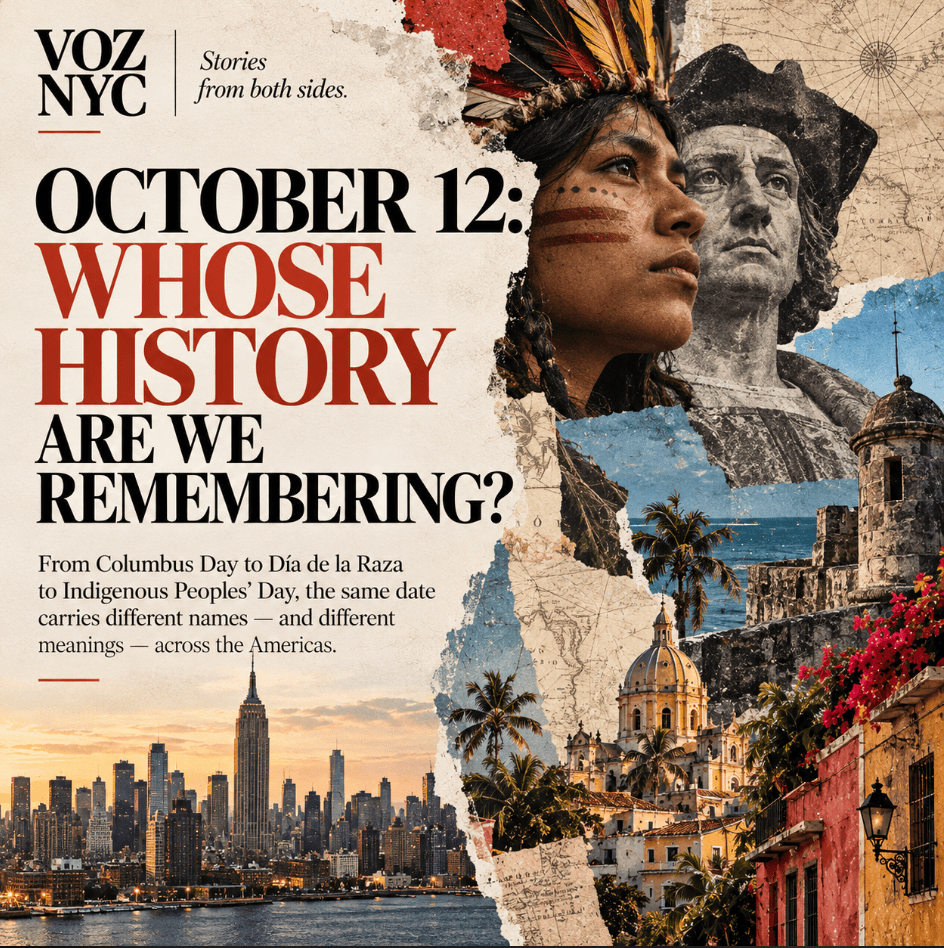
From Columbus Day to Día de la Raza and Indigenous Peoples’ Day, one date tells very different stories across the Americas. More than five centuries later, the debate is about much more than a name.
On October 12, 1492, Christopher Columbus and his crew arrived on an island in the Caribbean.
More than 500 years later, the date still appears on calendars across the Americas.
But what exactly are we remembering?
In the United States, it’s Columbus Day, a federal holiday that has long celebrated the Italian navigator and his place in American history. In many communities, the same day is recognized as Indigenous Peoples’ Day, honoring the cultures, histories and resilience of the people who inhabited the Americas long before European ships appeared on the horizon.
In Latin America, the date has carried names ranging from Día de la Raza to Día de la Resistencia Indígena.
One date. Different names. Very different meanings.
And behind those names is a much larger conversation about history, identity, colonization and who gets to tell the story.
Before Columbus, there was already a world
For generations, many students across the Americas learned that Columbus discovered America in 1492.
But the continent was never waiting to be discovered.
Long before Columbus arrived, the Americas were home to Indigenous civilizations, nations and communities with their own languages, political systems, economies, spiritual traditions and cultural achievements.
From the Taíno communities of the Caribbean to the Maya civilizations of Mesoamerica and the Inca Empire in South America, the Americas were already extraordinarily diverse.
Columbus’s arrival marked the beginning of sustained contact between Europe and the Americas, followed by centuries of conquest, colonization and profound social transformation.
European expansion brought new trade networks, languages, religions and cultural exchanges. It also brought forced labor, enslavement, dispossession, violence and diseases that devastated Indigenous populations.
Those histories are inseparable.
Yet for much of the twentieth century, public commemorations of October 12 frequently emphasized European exploration and the cultural ties between Spain and Latin America.
That emphasis would eventually face growing scrutiny.
How Día de la Raza became something else
For generations, October 12 was widely known across Spanish-speaking Latin America as Día de la Raza.
The term emerged from an early twentieth-century effort to celebrate the historical and cultural connections between Spain and the Spanish-speaking Americas.
But the idea of celebrating a shared Hispanic identity raised a fundamental question: whose identity was being recognized?
Indigenous communities, Afro-descendant populations and others whose histories were shaped by colonization often found themselves marginalized within traditional narratives of the holiday.
As movements for Indigenous rights and cultural recognition gained visibility, several countries began reconsidering how the date should be observed.
Argentina officially changed the holiday’s name in 2010 to Día del Respeto a la Diversidad Cultural, shifting the emphasis toward historical reflection, intercultural dialogue and respect for Indigenous peoples.
Venezuela adopted Día de la Resistencia Indígena in 2002, placing Indigenous resistance at the center of the commemoration.
Chile uses Día del Encuentro de Dos Mundos, a name that emphasizes the encounter between Europe and the Americas.
Other countries have developed their own approaches, reflecting different national histories and debates.
The changes demonstrate that the way a society remembers its past is not fixed.
It evolves.
And sometimes, changing the name of a holiday becomes a way of asking which parts of history have been overlooked.
In the United States, two observances share the calendar
In the United States, Columbus Day remains a federal holiday, observed on the second Monday of October.
For many Italian Americans, the holiday has also represented cultural heritage and recognition, particularly in the context of the discrimination Italian immigrants faced in American history.
But Columbus’s legacy has become increasingly contested.
For Indigenous communities and their supporters, celebrating Columbus can obscure the devastating consequences of European colonization for Native peoples.
Indigenous Peoples’ Day offers a different emphasis.
Rather than centering the arrival of a European explorer, it recognizes Indigenous histories, living cultures, contributions and resilience.
Across the country, cities, states, schools and institutions have adopted the observance, sometimes alongside Columbus Day and sometimes in its place.
In 2026, Columbus Day remains the federal holiday, while Indigenous Peoples’ Day continues to be recognized in many communities.
The two observances reflect different historical priorities, but they also reveal a broader question facing the country: how should a nation acknowledge both the communities that helped shape its modern identity and the injustices embedded in its past?
The Caribbean at the center of the story
For the Caribbean, October 12 carries particular historical significance.
Columbus’s first voyage reached the Bahamas, and his subsequent expeditions helped initiate European colonization throughout the region.
The Caribbean became one of the earliest centers of Spanish colonial expansion in the Americas.
Indigenous communities, including the Taíno, experienced catastrophic population losses and the destruction of many established social structures under colonial rule.
Over time, the region became a crossroads of Indigenous, European and African histories, profoundly shaped by the transatlantic slave trade and the development of plantation economies.
Those histories continue to influence Caribbean identities, languages, music, food, religion and cultural traditions today.
For people across the Caribbean diaspora, the legacy of colonization is not simply a chapter in a history book.
It is part of the story of how their societies came to exist.
Recognizing that complexity means acknowledging cultural survival and creativity without overlooking the suffering that accompanied conquest.
Can we celebrate culture without celebrating conquest?
Perhaps the most important question surrounding October 12 is whether recognizing the cultural connections created over centuries requires celebrating the conquest that helped produce them.
It doesn’t have to.
The Spanish language, for example, connects millions of people across the Americas and beyond. It has become a vehicle for extraordinary literature, music, journalism and cultural expression.
But Spanish is only one part of the region’s identity.
Hundreds of Indigenous languages continue to be spoken across Latin America, while African and Indigenous traditions remain fundamental to the cultural life of the continent.
The history of the Americas cannot be reduced to a single arrival, a single civilization or a single cultural inheritance.
It is a history of encounters, conflict, adaptation, survival and transformation.
And it belongs to far more people than those traditionally placed at the center of the narrative.
The history we choose to remember
There is something revealing about the fact that October 12 can mean such different things depending on where someone lives.
For one family, it may be Columbus Day.
For another, Día de la Raza.
For someone else, Indigenous Peoples’ Day, a moment to honor ancestors and recognize communities whose histories were too often excluded from textbooks.
Those differences are not simply about terminology.
They reflect how nations understand their origins, whose experiences they prioritize and how they confront the consequences of the past.
Changing the name of a holiday does not change what happened in 1492.
But it can change which questions we ask about what followed.
More than five centuries later, October 12 remains a reminder that history is not only about remembering events.
It is also about deciding whose voices deserve to be heard when we tell their stories.
And perhaps that is the question worth asking today: whose history are we remembering?

Leave a Reply